
WHEELS AND TIRES
Q-3prose procedureSpecial Notes About Wheels and Tires
- 1Do not use wheels or tires other than the specific types.
- 2Aluminum wheels are easily scratched. When washing them, use a soft cloth, never a wire brush. If the vehicle is steam cleaned, do not allow boiling water to contact the wheels.
- 3If alkaline compounds (such as saltwater or road salts) get on aluminum wheels, wash them as soon as possible to prevent damage. Use only a neutral detergent.
NOTES REGARDING TIRE REPLACEMENT
Note the following points when tires are to be removed from or mounted onto the wheels.
Tire Replacement Notes
- 1Be careful not to damage the tire bead, the rim bead, or the edge of the rim.
- 2Apply a soapy solution to the tire bead and the edge of the rim.
- 3Use a wire brush, sandpaper, or cloth to clean and remove all rust and dirt from the rim edge and the rim bead. For aluminum wheels, use only a cloth for this purpose; never use a wire brush or sandpaper.
- 4Remove pebbles, glass, nails, and other foreign items embedded in the tire tread.
- 5Be sure the air valve is installed correctly.
- 6After mounting a tire on a wheel, inflate it to 250—300 kPa (2.55—3.06 kgf/cm², 35.55—42.66 psi). Verify that the bead is seated correctly onto the rim and that there are no air leaks. Then reduce the pressure to the specified level.
- 7If a tire iron is used to change a tire on an aluminum wheel, be sure to use a piece of rubber between the iron lever and the wheel to avoid damage to the wheel. Work should be done on a rubber mat, not on a hard or rough surface.
INSPECTION / ADJUSTMENT
Check the following and adjust or replace as necessary.
Inspection / Adjustment
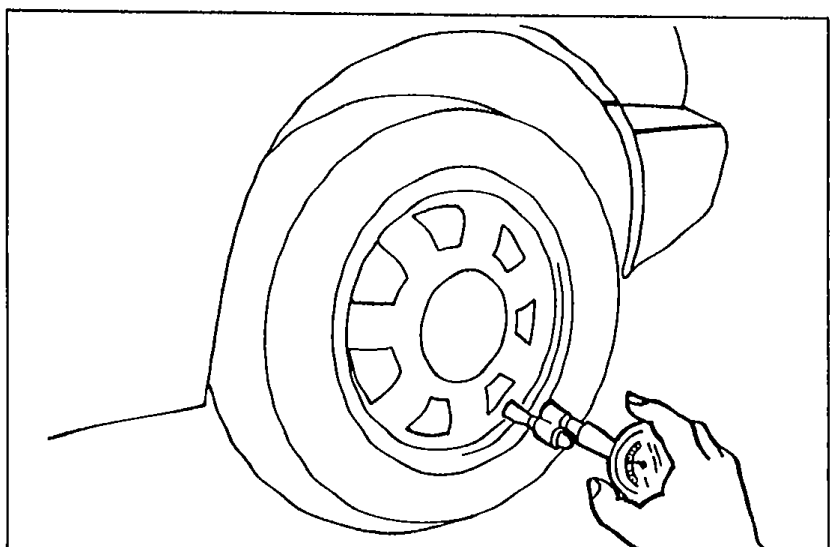
- 1Air pressure. Check the air pressure of all tires, including the spare tire, with an air pressure gauge.The air pressure must be measured when the tire is cold.
 05U0QX-005
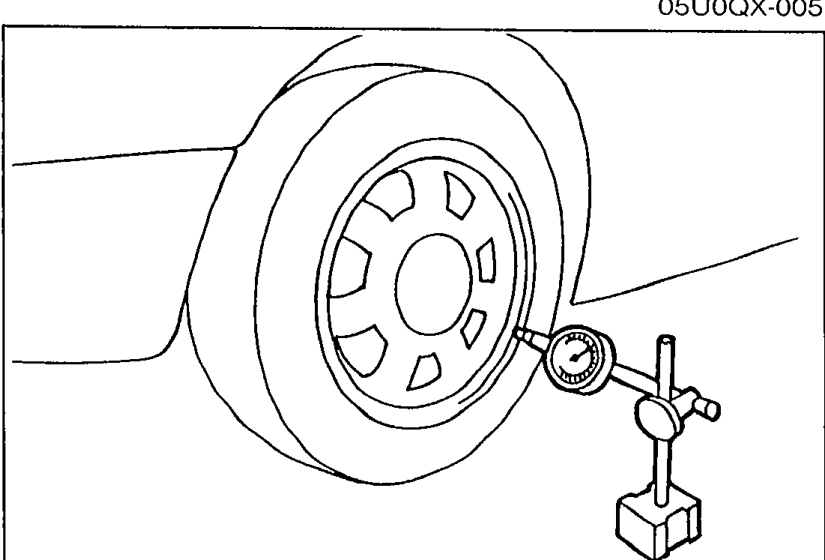
 - 2Wheel runout. Set the probe of a dial indicator against the wheel, and turn the wheel one full revolution.
 05U0QX-006
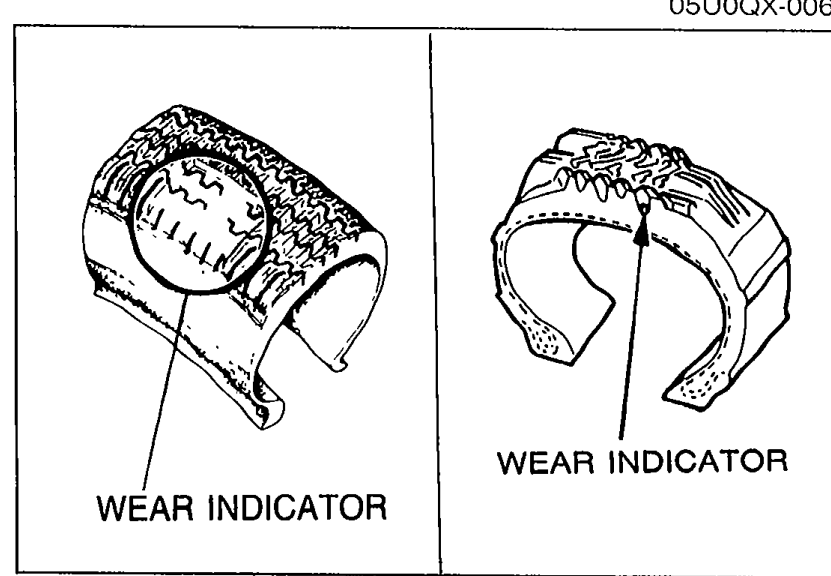
 - 3Tire wear.
 9MU0QX-008
| Specification | Value |
|---|---|
| Standard tiresair pressure | 177kPa (1.8 kgf/cm², 26 psi) |
| Temporary spare tiresair pressure | 412kPa (4.2 kgf/cm², 60 psi) |
| Wheel runout - Horizontalmax. | 2.0mm (0.079 in) |
| Wheel runout - Verticalmax. | 1.5mm (0.059 in) |
| Remaining tread - Ordinary tiresmin. Tire should be replaced if wear indicators are exposed. | 1.6mm (0.063 in) |
| Remaining tread - Snow tiresTire should be replaced if wear indicators are exposed. | 50%of tread |
Standard tiresair pressure
177kPa (1.8 kgf/cm², 26 psi)
Temporary spare tiresair pressure
412kPa (4.2 kgf/cm², 60 psi)
Wheel runout - Horizontalmax.
2.0mm (0.079 in)
Wheel runout - Verticalmax.
1.5mm (0.059 in)
Remaining tread - Ordinary tiresmin. Tire should be replaced if wear indicators are exposed.
1.6mm (0.063 in)
Remaining tread - Snow tiresTire should be replaced if wear indicators are exposed.
50%of tread