
WHEELS AND TIRES
Q-4prose procedureTroubleshooting guide
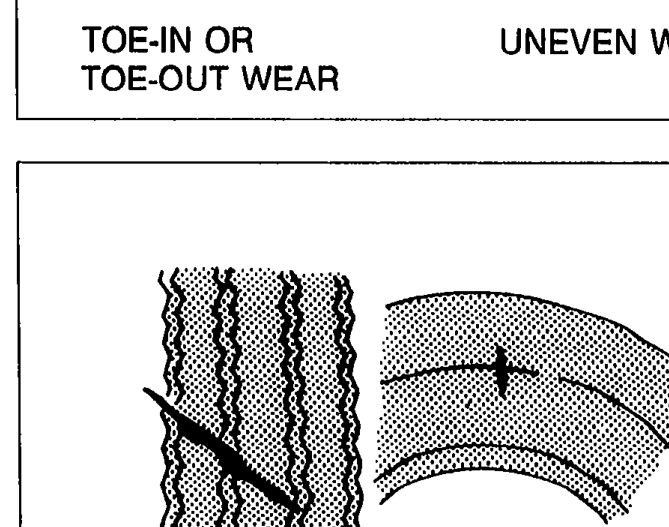
Abnormal tire wear patterns shown in the illustration can occur. Refer to the chart for the possible causes and actions.
Tire Wear Troubleshooting
(a)
Possible causeUnderinflation (both sides worn); Incorrect camber (one side worn); Hard cornering; Lack of rotation
ActionMeasure and adjust pressure; Repair or replace suspension parts; Reduce speed; Rotate tires
(b)
Possible causeOverinflation; Lack of rotation
ActionMeasure and adjust pressure; Rotate tires
(c)
Possible causeIncorrect toe-in
ActionAdjust toe-in
(d)
Possible causeIncorrect camber or caster; Malfunctioning suspension; Unbalanced wheel; Out-of-round brake drum or disc; Other mechanical conditions; Lack of rotation
ActionRepair or replace suspension parts; Repair or replace; Balance or replace; Correct or replace; Correct or replace; Rotate tires
Inspection (continued)
- 4Cracks, damage, and foreign matter (such as metal pieces, nails, and stones) in the tire and cracks, deformation, and damage to the wheel.
 05U0QX-008
 - 5Loose wheel lug nut(s).
- 6Air leaking from valve stem.
REMOVAL / INSTALLATION
Tighten the lug nuts to the specified torque in a crisscross fashion.
| Specification | Value |
|---|---|
| lug nuts | ≈863 - 1157N·m |
lug nuts
863 - 1157N·m
CAUTION
The wheel-to-hub contact surfaces must be clean.
Never apply oil to the nuts, bolts, or wheels, which cause looseness or seizure of the lug nuts.
TIRE ROTATION
To prolong tire life and assure uniform tire wear, rotate the tires every 6,000 km (3,750 miles), sooner if irregular wear develops.
CAUTION
Do not include "TEMPORARY USE ONLY" spare tire in rotation.
After rotating the tires, adjust each tire to the specified air pressure. (Refer to page Q-3.)